


 English
 한국어
한국어
 русский

Address:
No.233-3 Yangchenghu Road, Xixiashu Industrial Park, Xinbei District, Changzhou City, Jiangsu Province


Content
Yes—if the end mill is center-cutting (or specifically designed for plunging) and you use the right toolpath and cutting parameters. A standard non-center-cutting end mill should not be plunged straight down like a drill because it cannot clear chips at the center and is likely to rub, overheat, and break.
In practice, most shops avoid “true drilling” with an end mill unless the cutter and CAM strategy are chosen to manage chip evacuation (ramping, helical entry, or controlled peck-plunge). The deeper the hole and the tougher the material, the more important the strategy becomes.
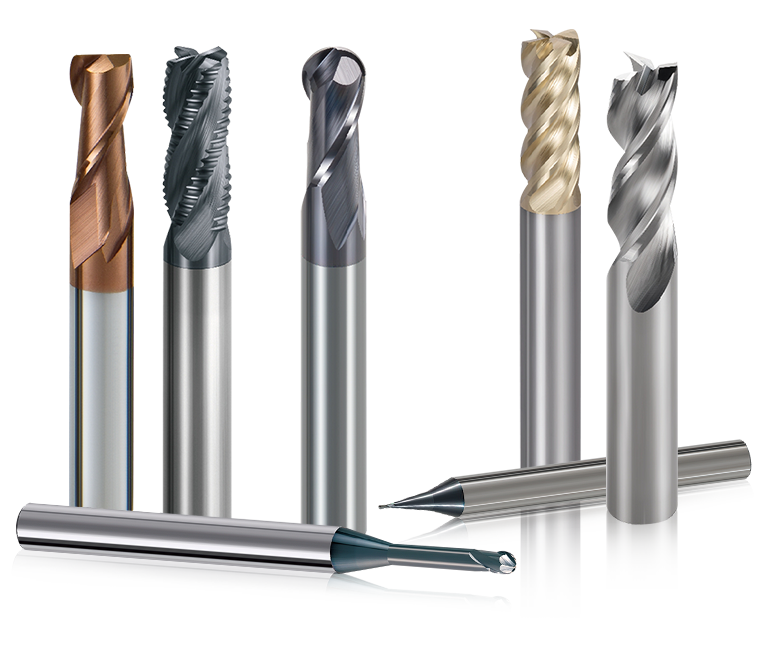
Shallow plunges for entry (for example, starting a pocket) are often fine. Deep, drill-like holes are where end mills struggle: chips pack in the flutes, heat rises, and the tool can snap. As a rule, the closer you get to a “hole” that is more than a few tool diameters deep, the more you should favor helical interpolation or a real drill.
Helical interpolation uses a circular motion while feeding down, so the end mill cuts more like a side-milling operation. This dramatically improves chip evacuation and reduces the rubbing that happens in a straight plunge.
Ramping feeds the cutter into the material at an angle (for example, 1–3 degrees) so the tool gradually engages rather than plunging at full axial engagement. This is commonly used to enter pockets without predrilling.
A straight plunge is the highest-risk method because chips have limited escape paths. If you must do it, use a cutter designed for plunging and consider a peck strategy (short down moves with retracts) to clear chips.
Assume a 6 mm (0.236 in) 3-flute carbide end mill running at 10,000 RPM with a side-milling chip load of 0.03 mm/tooth.
This does not guarantee safety (geometry and chip evacuation dominate), but it provides a rational starting point instead of guessing.
| Method | Chip evacuation | Typical use | Risk level |
|---|---|---|---|
| Helical interpolation | Excellent | Accurate holes, deep features | Low |
| Ramping | Good | Pocket entry, slot starts | Medium |
| Straight plunge (no peck) | Poor | Very shallow entry only | High |
| Peck plunge | Fair (depends on retract) | When helix/ramp is impossible | Medium–High |
If chips cannot evacuate, they recut, generate heat, and wedge the tool. This is why a “drill-like” plunge is risky: chips have nowhere to go. Helical entry, air blast, and shorter pecks reduce chip packing.
Even a center-cutting end mill has near-zero cutting speed at the exact center. Straight plunging increases the time spent cutting (or rubbing) at low surface speed, which drives heat. Keeping the tool moving laterally (helix/ramp) minimizes this effect.
End mills are less rigid than drills for axial loading. Deep plunges can produce a tapered or oversized hole and raise breakage risk. If hole accuracy matters, helical interpolation with a finishing pass is typically more predictable.
If the goal is a round hole with depth, speed, and good finish, a drill is usually the correct tool. Drills are designed for axial loads and chip evacuation in deep holes.
Helical interpolation is ideal when you want to create multiple hole diameters with one tool, when you need to avoid tool changes, or when you need a hole in thin material without grabbing.
A small pilot hole can provide chip space and reduce axial load when you must enter with an end mill. This is a practical compromise when CAM or machine limits make helical entry difficult.
You can drill down with an end mill, but you should treat it as a specialized operation. Use a center-cutting or plunge-rated tool, favor helical or ramp entry, keep plunge feeds conservative, and prioritize chip evacuation. If the feature is a deep, accurate hole, a dedicated drill (or a drill plus finishing strategy) is usually the safer and faster choice.

We are End Mills Manufacturer and End Mill Bits Factory. Our Footprints Are Around The World, We provide quality products and services to customers from all over the world.


No.233-3 Yangchenghu Road, Xixiashu Industrial Park, Xinbei District, Changzhou City, Jiangsu Province


+86-18068566610


sales@magotan-tools.com
+86-18068566610
