


 English
 한국어
한국어
 русский

Address:
No.233-3 Yangchenghu Road, Xixiashu Industrial Park, Xinbei District, Changzhou City, Jiangsu Province


Content
A CNC programmer once scrapped 40 end mills on a single batch of stainless steel parts. The problem wasn’t the tool quality — it was choosing 2 flutes instead of 4. That one decision cost thousands in tooling and downtime. Understanding the difference between 2-flute and 4-flute end mills isn’t just theory. It’s the dividing line between a profitable run and a pile of broken tools.
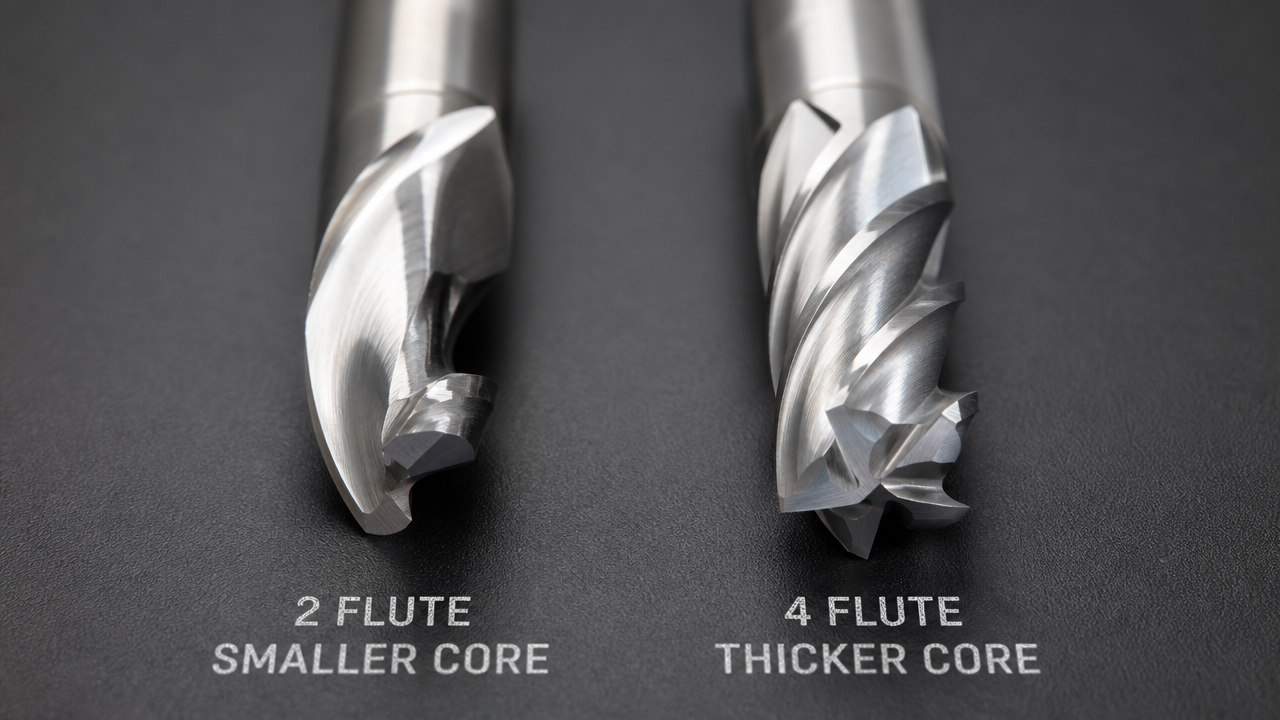
Every end mill is a compromise between strength and chip clearance. Add more flutes, and you increase the core diameter — the solid central mass of the tool. That directly boosts rigidity and resistance to deflection. But you also shrink the flute valleys, the channels that carry chips away from the cut. This trade-off is the physical reality behind every selection decision.
A 4-flute end mill typically has 15–20% more core cross-section than a comparable 2-flute design. In practice, that means it can handle 30–40% higher radial cutting forces before deflecting. For materials like 4140 alloy steel or Ti-6Al-4V titanium, where cutting pressures are high, that extra stiffness translates to tighter tolerances and longer tool life. The 2-flute tool, with its larger flutes, excels when chip volume is massive — think roughing 6061 aluminum at 1,200 IPM. The chips need somewhere to go, and narrow flutes simply pack up.
This balance plays out in every dimension of the tool. A 1/2-inch 2-flute end mill might have a flute valley depth of 0.120 inches. A 4-flute version of the same diameter often drops to 0.080 inches. That 33% reduction in chip space is why machinists see rapid chip packing and tool failure when using 4-flute tools in soft, gummy materials without adjusting stepover and speeds.
The old shop-floor rule holds up remarkably well: use 2 flutes for non-ferrous metals, 4 flutes for ferrous ones. Aluminum and brass produce long, continuous chips that demand open flute valleys. Steel, with its shorter, segmented chips and higher tool pressure, rewards the extra core strength of a 4-flute design. But this rule is just a starting point.
Material hardness drives the logic. 6061 aluminum cuts at under 100 Brinell — the tool barely feels resistance, so chip evacuation is the only bottleneck. 4140 chrome-moly steel at 28–32 HRC, however, requires serious rigidity. Here, a high-performance 4-flute flat end mill with a reinforced core will outperform any 2-flute tool. The rule works 80% of the time. The other 20% depends on application and machine capability.
Quick reference for common base materials:
The matrix below maps eight common engineering materials against 2-flute, 3-flute, and 4-flute end mills. Ratings are based on actual machining feedback from tooling engineers and reflect the best balance of tool life, surface finish, and material removal rate for typical operations.
| Material | 2-Flute | 3-Flute | 4-Flute |
|---|---|---|---|
| 6061 Aluminum | 3 | 2 | 1 |
| 7075 Aluminum | 3 | 2 | 1 |
| 1018 Mild Steel | 1 | 2 | 3 |
| 4140 Alloy Steel (28 HRC) | 1 | 1 | 3 |
| 304 Stainless Steel | 1 | 2 | 3 |
| Ti-6Al-4V Titanium | 1 | 1 | 3 |
| Gray Cast Iron | 1 | 2 | 3 |
| P20 Mold Steel (32 HRC) | 1 | 1 | 3 |
For stainless steel alloys like 304 or 316, the high work-hardening rate demands a rigid tool with controlled chip engagement. Specialized geometries — such as the 4-flute unequal tooth pitch end mill for stainless steel — break up harmonic vibration and maintain cutting edge integrity far longer than generic 4-flute designs. In titanium, where heat concentrates at the cutting edge, a sharp 4-flute with AlTiN coating is the only reliable choice for production.
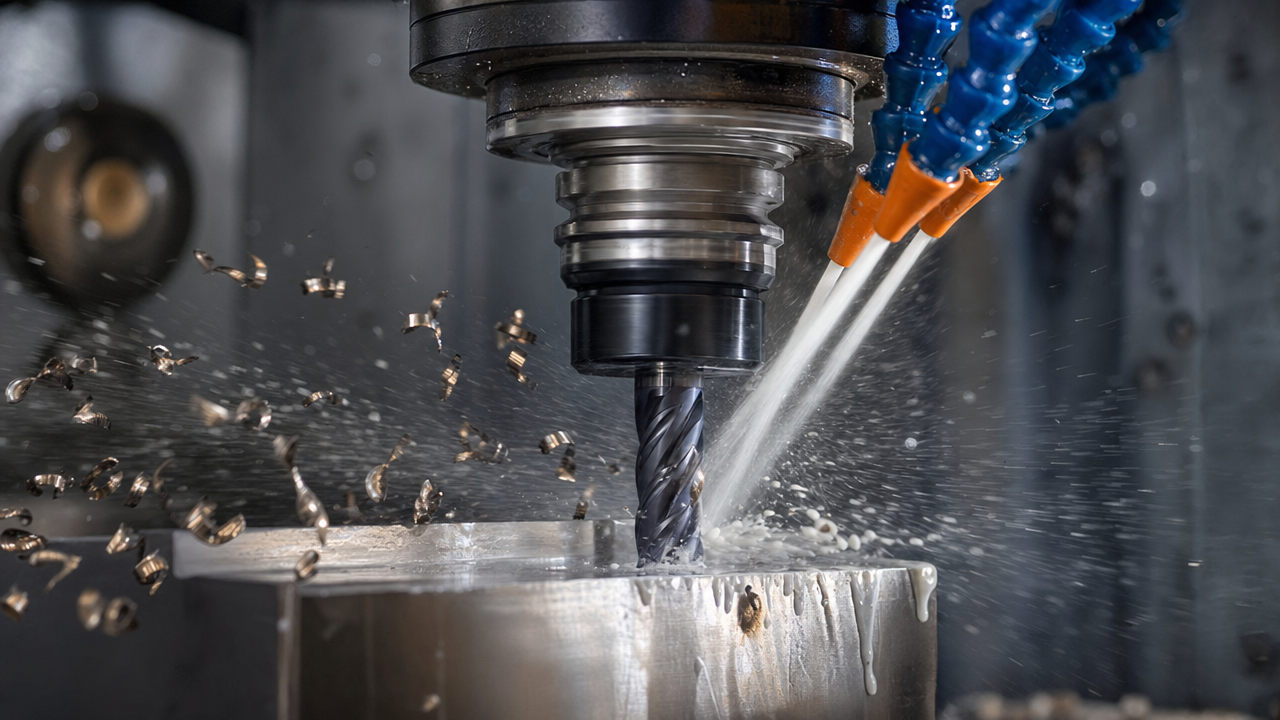
Flute count selection shifts dramatically between roughing and finishing passes. Roughing operations aim for maximum material removal rate — chip evacuation is the priority. A 2-flute tool in aluminum can handle a 0.020–0.025 inch chip load per tooth because the massive flutes clear chips instantly. The same cut with a 4-flute tool would pack chips, spike spindle load, and snap the tool within seconds.
Finishing is the opposite. Here, surface finish and dimensional accuracy matter most. A 4-flute end mill with its larger core produces lower radial deflection, directly translating to better surface finish. The finer tooth pitch also means each cutting edge enters the material more frequently, smoothing out the scalloped finish left by fewer flutes. For a 1/2-inch end mill finishing a wall in 4140 steel, a 4-flute tool consistently delivers Ra values 20–30% better than a comparable 2-flute.
Between the extremes sits the 3-flute end mill. It offers 50% more core than a 2-flute while retaining roughly 15% more flute volume than a 4-flute. This makes it the tool of choice for high-performance aluminum finishing, where you need better rigidity than a 2-flute but can’t afford the chip-packing risk of a 4-flute. Many aerospace shops have standardized on 3-flute tools for 7075 aluminum structural parts.
The 3-flute also shines in slotting operations on mild steel when machine rigidity limits the use of 4-flute tools. Its asymmetric cutting forces damp vibration naturally. For a hobbyist running a benchtop mill, a sharp 3-flute end mill often achieves what a 4-flute cannot — stable cutting without chatter. However, it’s not a universal solution. In hardened materials above 45 HRC, the edge durability of a 4-flute still dominates.
When end mill diameter drops below 1/8 inch (3 mm), the rules reverse. Flute volume shrinks exponentially, and chip evacuation becomes the overriding concern. A 0.062-inch 4-flute end mill has pitifully small flutes — almost certain to clog in any material that produces continuous chips. For micro-machining in aluminum, a 2-flute — or even a single-flute — tool is essential. The same applies to plastics and soft materials where melting and smearing kill small tools.
On low-rigidity machines like CNC routers, bench mills, and engraving machines, tool deflection can overwhelm any material advantage. A 2-flute end mill for aluminum generates lower radial cutting forces, reducing the chance of chatter and breaking. Even when cutting mild steel on a gantry router, a sharp 2-flute with light radial engagement often outperforms a 4-flute that would shake the entire frame. The trade-off is slower feed rates, but the alternative is no cut at all.
Real numbers cut through theory. The table below lists practical starting parameters for a 1/2-inch diameter carbide end mill in two common scenarios. These assume a rigid CAT40/BT40 machining center with flood coolant. Adjust linearly for smaller diameters and derate by up to 30% for less rigid setups.
| Scenario | Speed (RPM) | Feed per Tooth (IPT) | Axial Depth (Ap) | Radial Depth (Ae) |
|---|---|---|---|---|
| 2-Flute / 6061 Al / Roughing | 12,000 | 0.022 | 0.75 x D | 0.40 x D |
| 2-Flute / 6061 Al / Finishing | 14,000 | 0.012 | 0.50 x D | 0.05 x D |
| 4-Flute / 4140 Steel (30 HRC) / Roughing | 2,800 | 0.006 | 0.50 x D | 0.25 x D |
| 4-Flute / 4140 Steel (30 HRC) / Finishing | 3,500 | 0.004 | 0.40 x D | 0.03 x D |
| 4-Flute / 304 Stainless / Roughing | 1,800 | 0.004 | 0.35 x D | 0.20 x D |
| 4-Flute / Ti-6Al-4V / Roughing | 1,200 | 0.003 | 0.30 x D | 0.15 x D |
Coatings magnify these numbers. A 4-flute tool with AlTiN coating can run 15–20% faster than an uncoated tool in steel, while a DLC coating on a 2-flute aluminum tool nearly eliminates built-up edge. The synergy between flute count and coating chemistries is a force multiplier — but it never overrides the fundamental physics of core and flute volume.
The decision between 2 and 4 flutes isn’t a vote — it’s a calculation. Start with your workpiece material. If it’s aluminum or brass, 2 flutes will keep your machine running. If it’s steel, stainless, or titanium, 4 flutes will give you the edge strength and surface finish you need. Then factor in your machine’s rigidity and the operation: roughing, finishing, or slotting.
The 3-flute option fills the gaps, and the rules bend completely for small diameters. Every job is a new equation. But with the data and tables above, you can solve it before the first chip flies.

We are End Mills Manufacturer and End Mill Bits Factory. Our Footprints Are Around The World, We provide quality products and services to customers from all over the world.


No.233-3 Yangchenghu Road, Xixiashu Industrial Park, Xinbei District, Changzhou City, Jiangsu Province


+86-18068566610


sales@magotan-tools.com
+86-18068566610
