


 English
 한국어
한국어
 русский

Address:
No.233-3 Yangchenghu Road, Xixiashu Industrial Park, Xinbei District, Changzhou City, Jiangsu Province


Content
The 1/4-28 UNF thread is a fine-pitch unified thread defined by ASME B1.1 with 28 threads per inch. Its nominal diameter is 0.250 inch (6.35 mm). The dimensions below cover the two most common tolerance classes — 2A for external threads and 2B for internal threads — and include both inch and metric equivalents for direct use in design and inspection.
For external threads (Class 2A), the major diameter has an allowance of 0.0010 inch, which means the maximum material condition is intentionally undersized to accommodate plating or coatings. The tolerance on the pitch diameter is 0.0033 inch, tighter than the comparable 1/4-20 UNC thread.
| Parameter | Max (inch) | Min (inch) | Max (mm) | Min (mm) |
|---|---|---|---|---|
| Major Diameter | 0.2490 | 0.2425 | 6.3246 | 6.1595 |
| Pitch Diameter | 0.2258 | 0.2225 | 5.7353 | 5.6515 |
| Minor Diameter (UNR) | 0.2085 | 0.1918 | 5.2959 | 4.8717 |
| Pitch (1/28) | 0.0357 | — | 0.9071 | — |
Internal threads (Class 2B) have no allowance; the minor diameter provides clearance for the external thread’s crest. The pitch diameter tolerance provides a functional fit without excessive galling.
| Parameter | Min (inch) | Max (inch) | Min (mm) | Max (mm) |
|---|---|---|---|---|
| Minor Diameter | 0.2110 | 0.2170 | 5.3594 | 5.5118 |
| Pitch Diameter | 0.2268 | 0.2311 | 5.7607 | 5.8699 |
| Major Diameter (min.) | 0.2500 | — | 6.3500 | — |
Data above aligns with ASME B1.1 for UNF threads. Always verify against the applicable standard revision for critical applications.
Three diameters define every unified thread form. The major diameter is the largest diameter of the thread — on an external thread this is the crest-to-crest measurement; on an internal thread it’s the root-to-root dimension at the bottom of the groove. For 1/4-28 UNF, the nominal major diameter is 0.250 inch.
The pitch diameter sits approximately halfway between the major and minor diameters. It is the theoretical diameter where the thread thickness equals the gap between threads. All functional fit and strength calculations reference the pitch diameter because it controls the contact area.
The minor diameter is the smallest diameter. On an external thread it is the root diameter; on an internal thread it is the crest diameter. The minor diameter of an internal thread (0.211–0.217 inch) directly determines the tap drill size selection.
The 1/4-28 UNF and 1/4-20 UNC share the same nominal size, but the thread pitch changes everything. UNF has a pitch of 0.0357 inch (28 TPI), while UNC uses 0.0500 inch (20 TPI). The finer pitch of UNF results in a shallower thread depth — 0.0156 inch compared to 0.0271 inch for UNC — which leaves more material cross-section in the fastener and increases tensile strength by roughly 10–15% for the same external diameter.
UNF threads also exhibit better vibration resistance. The finer helix angle increases the friction under load, reducing the tendency to loosen. That’s why automotive sensor bosses and aerospace hydraulic fittings frequently specify 1/4-28 UNF. However, fine threads are more prone to cross-threading during assembly and require tighter control of the starting alignment.
UNC is the default choice for general fastening where speed of assembly and forgiveness matter. When vibration, precision, or higher preload capacity is required, 1/4-28 UNF becomes the correct call. The table below summarizes the key differences.
| Feature | 1/4-28 UNF | 1/4-20 UNC |
|---|---|---|
| Pitch | 0.0357 in (0.907 mm) | 0.0500 in (1.270 mm) |
| Thread depth | 0.0156 in | 0.0271 in |
| Tensile stress area | 0.0364 in² | 0.0318 in² |
| Vibration resistance | High | Moderate |
| Assembly risk | Cross-threading sensitive | Forgiving |
| Typical use | Precision instruments, hydraulics, aerospace | Structural fasteners, general machinery |
The tap drill size for a 1/4-28 UNF internal thread must produce a hole between the minor diameter limits of 0.211 and 0.217 inch. A standard formula — tap drill diameter = nominal diameter − pitch — gives a theoretical value of 0.250 − 0.0357 = 0.2143 inch. In practice, machinists use a #3 drill bit (0.2130 inch) or a 5.5 mm drill (0.2165 inch). Both fall within the acceptable range, but material type dictates the final choice.
For aluminum and other soft materials, the smaller #3 drill promotes a higher percentage of thread engagement, typically around 75–80%, which maximizes pull-out strength. For stainless steel or titanium, where tapping torque is high, a 5.5 mm drill reduces thread engagement to roughly 65% and extends tool life significantly. If thread milling is used instead of tapping, these constraints loosen further because the cutter generates the internal form without the same thrust loads.
Always check the minor diameter after drilling. A worn drill or excessive runout can produce an oversized hole that falls below the 0.211 inch minimum, rendering the thread nonconforming.
The production method for a 1/4-28 UNF thread directly affects cost, quality, and throughput. Tapping remains the fastest way to create internal threads in high-volume applications, but it can be unforgiving on tough materials. Thread milling provides greater control and is gentler on the workpiece. Single-point turning on a lathe is still the standard for external threads on turned parts. The following table breaks down the comparison.
| Method | Internal/External | Typical Accuracy | Best for Batch Size | Tool Cost | Main Limitations |
|---|---|---|---|---|---|
| Tapping | Internal | Class 2B standard; difficulty reaching 3B | Large (500+) | Low | Torque spike, chip evacuation in blind holes, limited material range |
| Thread Milling | Internal/External | Class 3A/3B achievable | Small to medium | Medium | Slower cycle time, requires helical interpolation capability |
| Turning | External | Class 3A easily | Any | Low | Only external threads; needs rigid setup for fine pitch |
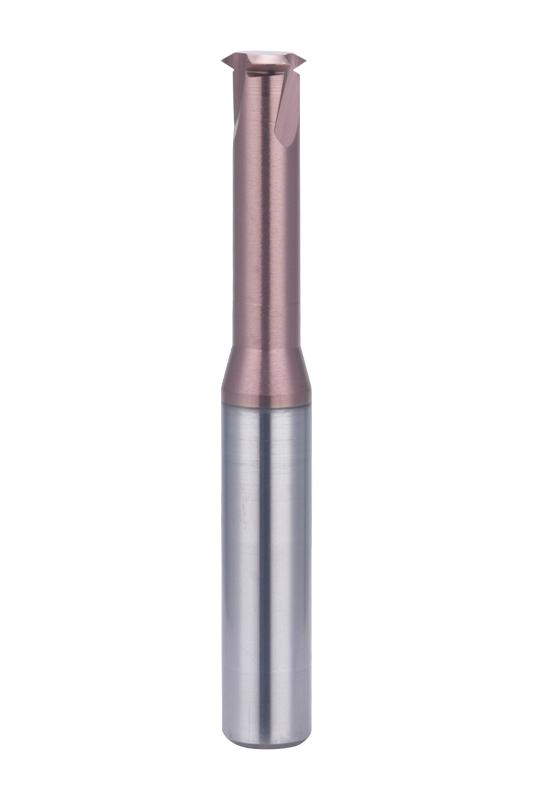
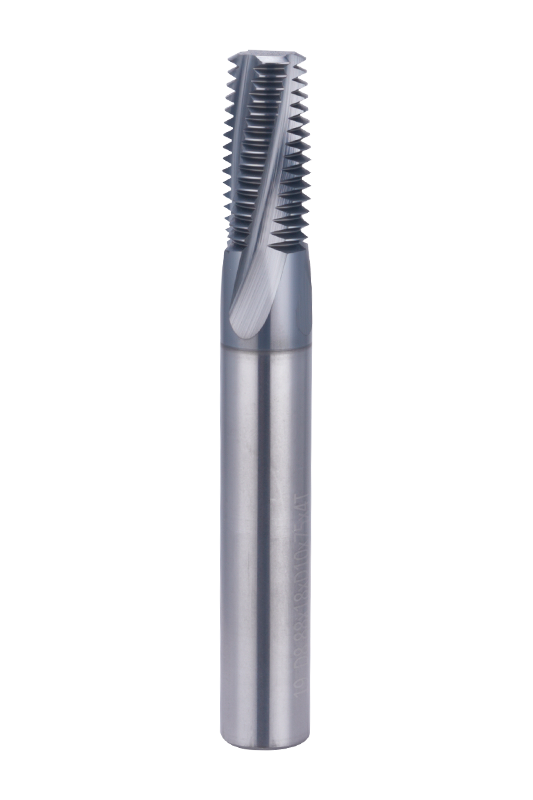
Thread milling stands out when material toughness (e.g., Inconel, hardened steel above 45 HRC) makes tapping risky. A single solid carbide thread mill can adjust to different diameters by changing the toolpath radius, and one pass can produce a full profile thread with excellent surface finish. For 1/4-28 UNF, a full-tooth thread milling cutter reduces the number of passes and guarantees correct form even on interrupted cuts.
Turning remains the default for external 1/4-28 UNF threads on turned components. Using a 60° full-profile insert ensures that the crest and root radii meet standard specifications, and the pitch diameter can be held to ±0.0005 inch on a well-maintained CNC lathe.
When thread milling 1/4-28 UNF in a machining center, the cutting parameters must balance tool life and thread quality. The fine pitch does not demand heavy chip loads; instead, stable radial engagement controls accuracy. The table below lists starting parameters for common workpiece materials using coated carbide thread mills with a cutting diameter of approximately 0.200 inch.
| Material | Cutting Speed (SFM) | Feed per Tooth (in/tooth) | Radial DOC (in) |
|---|---|---|---|
| Aluminum 6061 | 250–400 | 0.002–0.004 | 0.010–0.015 |
| Low-carbon steel (1018) | 150–220 | 0.0015–0.0025 | 0.008–0.012 |
| Stainless steel 304 | 100–150 | 0.001–0.0015 | 0.005–0.008 |
| Titanium Grade 5 | 80–120 | 0.0008–0.0012 | 0.004–0.006 |
Reduce the radial depth of cut when entering the hole to control tool deflection in small diameters. Always use climb milling and apply minimum quantity lubrication or flood coolant to evacuate the fine chips that 28 TPI generates; chip re-cutting immediately degrades the pitch diameter finish.
Unified thread tolerance classes define the fit between external and internal threads. Class 2A (external) and 2B (internal) are the most common pair for general mechanical assemblies. They provide a balanced clearance that accommodates minor misalignment and surface coatings while remaining functionally tight.
Class 3A and 3B are precision fits with approximately half the pitch diameter tolerance of the class 2 pair. For 1/4-28 UNF, the 3A pitch diameter tolerance is 0.0018 inch compared to 0.0033 inch for 2A. These tight fits demand high-quality tooling and rigid setups; they eliminate perceptible backlash and are specified in aerospace fasteners and instrument lead screws. The internal thread minor diameter for class 3B is also held to a narrower range than 2B, typically requiring a finishing tap or reaming before threading.
Choosing 3A/3B generates higher manufacturing cost but guarantees interchangeability under high vibration and thermal cycling. Most industrial 1/4-28 UNF applications run safely at class 2 unless the design specification mandates otherwise.
The 1/4-28 UNF thread appears in components where size, weight, and reliability intersect. Typical applications include:

We are End Mills Manufacturer and End Mill Bits Factory. Our Footprints Are Around The World, We provide quality products and services to customers from all over the world.


No.233-3 Yangchenghu Road, Xixiashu Industrial Park, Xinbei District, Changzhou City, Jiangsu Province


+86-18068566610


sales@magotan-tools.com
+86-18068566610
