


 English
 한국어
한국어
 русский

Address:
No.233-3 Yangchenghu Road, Xixiashu Industrial Park, Xinbei District, Changzhou City, Jiangsu Province


Content
Ask ten machinists to describe a bull nose end mill and you will hear ten versions of the same idea: a flat-bottomed cutter with a small radius ground into the corners where the bottom cutting edge meets the periphery. That single radius, often just a fraction of the tool diameter, quietly changes how the cutter enters the material, how heat leaves the cutting zone, and how long the tool survives before it needs replacing.
We grind these corner radii every day at our plant in the Xixiashu tool-making cluster in Changzhou, in diameters from a few tenths of a millimeter up to large roughing cutters for mold work. This guide is what we share with customers who call and ask which geometry to put in the spindle: what a bull nose end mill really is, when it beats a square or ball nose tool, and how to choose and run one so that it pays for itself.
A bull nose end mill, also called a corner radius end mill or a toroidal cutter, keeps the flat bottom of an ordinary square end mill but replaces the sharp 90-degree corner with an arc. The tool still cuts a flat floor, yet the transition between the bottom edge and the helical flute is a smooth radius instead of a fragile point.
That arc is defined by its corner radius, usually written as R. Values typically run from R0.2 mm for fine finishing of hardened steel up to R6 mm or more for heavy roughing. Some catalogs describe the same feature by corner diameter, which is simply twice the radius. When you see bull nose and corner radius used side by side, they refer to identical geometry.
One clarification saves a lot of confusion at the quoting stage: a bull nose end mill is not a corner rounding cutter. A corner rounding tool is a form cutter that puts a radius on the outside edge of a part. A bull nose tool puts a radius into the internal corner of a pocket.
Carbide is hard, but it is not tough. A sharp corner concentrates stress into a tiny volume of material, and under interrupted cuts, hard inclusions, or a slightly aggressive feed rate, that corner chips first. Grinding a radius into it spreads the load across a wider arc, which is exactly why bull nose tools tolerate roughing far better than their square cousins.
When a square tool sweeps a floor, the sharp corner drags and burnishes, leaving witness marks behind. The radius on a bull nose cutter smooths that transition, so floors come out cleaner and internal corners match the drawing without a second operation.
Because the corner is stronger and the load is distributed, a bull nose end mill usually holds its edge longer between regrinds. That predictability matters on lights-out machines. The radius also allows a wider stepover at the same chip load and enables radial chip thinning strategies that raise feed rates while keeping the tool stable. In high-feed milling, the corner radius is the entire point of the design.
| Tool type | Corner geometry | Best suited to | Trade-offs |
|---|---|---|---|
| Square end mill | Sharp 90-degree corner | Square shoulders, slots, flat floors and walls | Weakest corner, chips in interrupted cuts, leaves witness marks |
| Bull nose end mill | Flat bottom with radiused corners | Roughing and semi-finishing of pockets, mold cavities, radii, high-feed milling | Cannot reach fully into a sharp internal corner |
| Ball nose end mill | Full radius equal to half the diameter | 3D contouring, sculpted surfaces, deep cavities | No flat floor, lower removal rate on flat work |
The choice is rarely about which tool is best in general. It is about what the part needs: a sharp internal corner, a specific corner radius on the drawing, or free-form surface blending. When the print calls for a radius, the bull nose cutter is the only geometry that produces it in one pass.
Corner radius tools show up wherever a shop needs both serious material removal and control over the corner. A few examples from our order book:
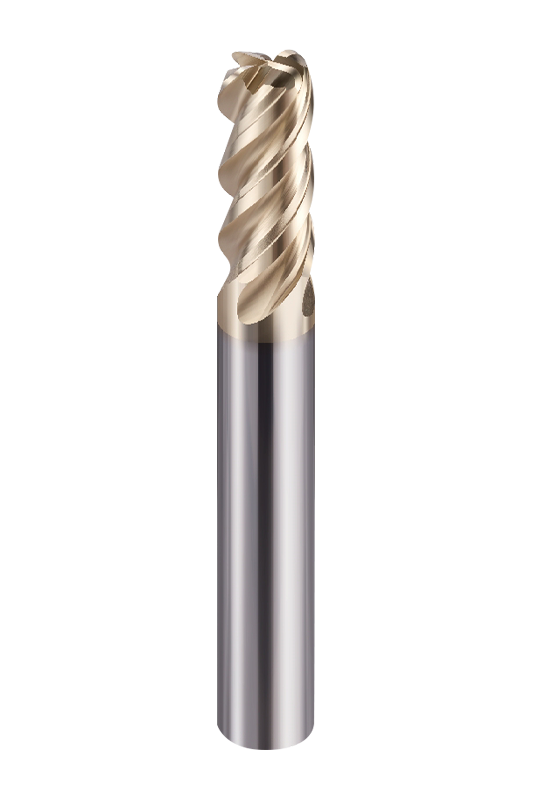 4 Flute Round Nose Titanium Alloy Milling Cutters• The variable helix angle and unequal division design bring anti-vibration performance, mainly for titanium alloy material processing. • The ultra-large chip space ac...View Product →
Start from the drawing, not the catalog. If the print specifies R1.0, order R1.0 rather than the nearest stock size. For roughing only, a larger radius such as R2 mm or R3 mm gives a stronger edge and better chip thinning, even when the finished corner will be smaller.
Two or three flutes suit aluminum and non-ferrous work because they clear chips quickly. Four flutes are the general-purpose default for steel. Five and six flutes come into their own on hardened material and finishing passes, where a stiff core and higher feed rate matter more than chip room. Our comparison of two-flute and four-flute geometry explains the flute count decision in more detail.
For steels and stainless, a fine-grain carbide with an aluminum titanium nitride coating covers most work. Titanium and nickel alloys benefit from an aluminum chromium based coating and a sharper, polished edge. Graphite and copper call for uncoated or diamond-like surfaces. If you are cutting above 45 HRC, an ultra-hard grade with a honed edge will outlast a general-purpose tool by a wide margin.
Keep the gauge length as short as the part allows. Every extra millimeter of overhang multiplies deflection, and a bull nose tool with a small radius is far less forgiving of runout than a square cutter. Check runout at the flute, not at the shank.
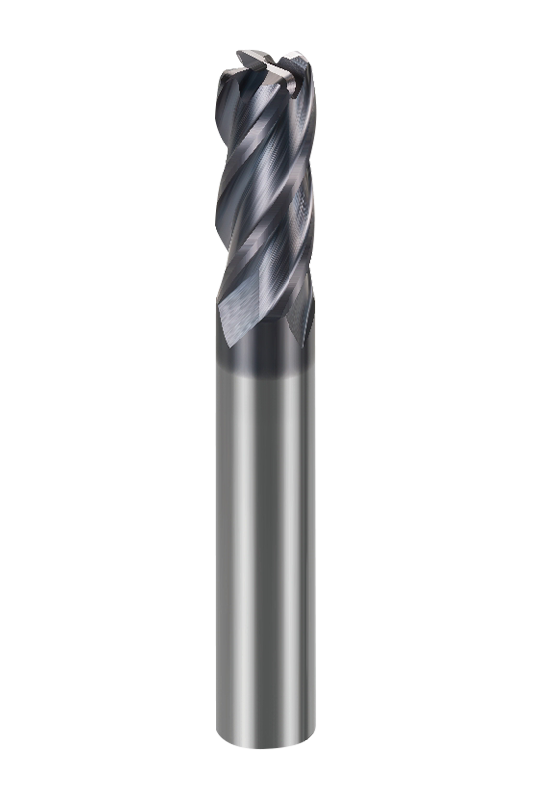 4 Flute Round Nose End Mills• The universal milling cutter is suitable for heat treatment of all series of steel materials. It has a U-groove structure design and is suitable for both roughing an...View Product →
Bull nose tools are almost always programmed with a stepover smaller than the radius, which means the actual chip thickness at the cutting edge is smaller than the programmed feed per tooth. Machinists who ignore this run the tool too gently, rub the edge, and wonder why the coating wears off so quickly. Apply a radial chip thinning compensation to the feed rate, and the tool will cut rather than polish.
The same logic applies to depth of cut. A bull nose cutter with a generous radius can take a deep axial cut with a light radial engagement, shifting the load to the stronger part of the edge and moving heat away with the chip. That is the principle behind high-feed and dynamic roughing cycles. Do not simply copy the parameters from a square tool of the same diameter; the effective cutting diameter at the corner is different, and so is the ideal surface speed.
Most premature failures we see on returned tools come down to a handful of habits:
Wipe tools down after use, protect the flutes in their sleeves, and inspect the corner under light every few hours of cutting. A small radius that has begun to wear flat is a warning, and replacing or regrinding early is always cheaper than scrapping a cavity. For hardened and high-precision work, our ultra-hard series holds a fine corner radius and a polished edge over long cycles.
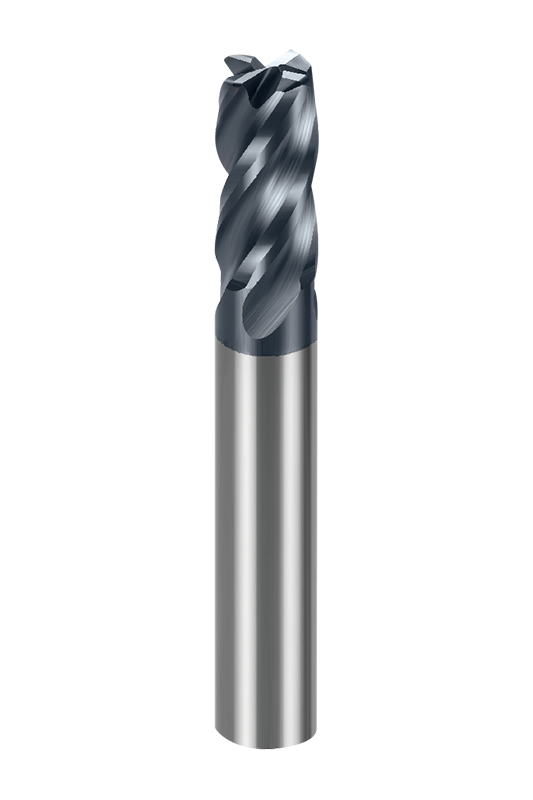 High-Precision 4 Flute Round Nose End Mills• Advanced grinding technology achieves ultra-high blade diameter and shank diameter accuracy, suitable for precision molds and parts processing. • High wear-resistant...View Product →
Geometry decisions are usually cost decisions in disguise. A bull nose end mill costs a little more to grind than a plain square tool, yet it removes material faster, finishes corners in one pass, and survives longer in the spindle. Those three effects usually outweigh the price difference within a single production run.
If you are still unsure which radius, flute count, or coating fits your job, send us the part drawing and the material. Our engineers will look at the corner geometry and the machine before recommending anything, which is exactly how we have built our solid carbide end mill range over the years.

We are End Mills Manufacturer and End Mill Bits Factory. Our Footprints Are Around The World, We provide quality products and services to customers from all over the world.


No.233-3 Yangchenghu Road, Xixiashu Industrial Park, Xinbei District, Changzhou City, Jiangsu Province


+86-18068566610


sales@magotan-tools.com
+86-18068566610
