


 English
 한국어
한국어
 русский

Address:
No.233-3 Yangchenghu Road, Xixiashu Industrial Park, Xinbei District, Changzhou City, Jiangsu Province


Content
Ask any mold maker or toolroom hand which cutter spends the most hours in the spindle, and the answer is usually the same: a ball nose end mill. Its rounded tip is the only geometry that follows the free-form surfaces inside a cavity, blends a radius into a wall, and sweeps across a curved electrode without leaving a sharp step behind.
At Changzhou Maton Tools we grind these cutters every working day, in diameters from a fraction of a millimeter up to full mold-sized tools. Over the years we have learned that most ball nose problems are decided long before the tool touches the workpiece. Flute count, effective diameter, stepover and coating all interact, and a cutter that performs beautifully on one job can fail on the next.
This guide explains what a ball nose end mill actually is, where it belongs in a process, and how we help customers pick one that survives the whole cycle.
A ball nose end mill, also called a full-radius end mill, ball cutter or ball end mill, is a milling cutter whose tip is ground to a single constant radius equal to half the tool diameter. A 10 mm ball nose cutter carries a 5 mm radius at its tip, and that radius is identical in every direction, so the tool presents a true half sphere to the workpiece.
The shape matters more than it appears. Because the tip is a continuous radius rather than a sharp corner, there is no point where the edge digs in and no square shoulder left in the cut. As the tool travels along its toolpath, the contact point slides across the ball, and that is exactly what allows it to generate curved, three-dimensional surfaces. A flat end mill leaves a step at every change of direction, while a corner radius or bull nose cutter only softens the corner without producing a spherical form.
Solid carbide ball nose end mills are ground from a single carbide blank. The helix, the tip gash, the primary relief and the coating are produced in sequence on five-axis and six-axis CNC grinding centres. A tapered ball nose cutter follows the same principle but mounts the ball on a tapered neck, adding rigidity when a mold has deep, narrow ribs that a straight shank simply cannot reach.
Anywhere a surface curves in two directions at once, a ball nose end mill is the default choice. In our customers' shops that usually means:
The surface a ball nose cutter leaves is never perfectly smooth. Successive passes leave a row of tiny cusps known as scallops, and the height of those scallops, not the cutter itself, usually determines how much hand polishing follows.
Flute count is the first decision on the specification sheet, and it is really a trade-off between chip room and tooth count. More flutes mean more cutting edges passing per revolution and therefore a higher table feed at the same chip load, but they also leave less space for the chip to escape.
| Flute count | Chip room | Typical materials and jobs | What to watch |
|---|---|---|---|
| 2 flutes | Excellent | Aluminium, copper electrodes, graphite, micro diameters below 3 mm | Fewer teeth, so raise the feed per tooth rather than the table feed |
| 4 flutes | Good | General steel, stainless steel, titanium, mold finishing | The workhorse choice for most 3D contouring |
| 6 flutes and above | Limited | Hardened mold steel above 45 HRC, final finishing passes | Keep the radial stepover small and control runout |
Beyond flute count, look closely at helix angle, gash geometry and whether the flutes are equally or unequally spaced. Unequal pitch breaks the regular rhythm of tooth impacts and is a proven way to push chatter out of a cut in stainless steel and titanium.
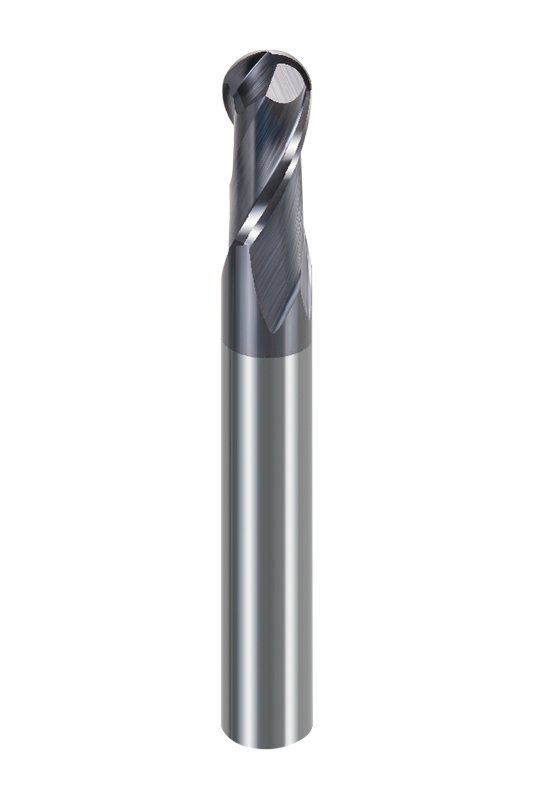 2 Flute Ball Nose End Mills• The universal milling cutter is suitable for heat treatment of all series of steel materials. It has a U-groove structure design and is suitable for both roughing an...View Product →
For ordinary carbon and alloy steels, a 4-flute ball nose cutter from a universal series covers most semi-finishing and finishing work, and it tolerates the widest range of conditions. Start with a moderate surface speed, keep the stepover between 5 and 15 percent of the diameter, and apply generous coolant or high-pressure air to move the chips clear of the cut.
These materials work-harden quickly and generate high cutting temperatures, so rubbing is the real enemy. Unequal pitch geometry, a sharper edge and a slightly reduced surface speed all help. Titanium in particular benefits from a cutting edge that stays in the cut rather than dwelling at the bottom of a contour pass, which is why a controlled ramp or helical entry usually outperforms a straight plunge.
Once you pass roughly 45 HRC, tool life is driven by coating and substrate rather than by flute geometry alone. An aluminium chromium nitride coating and a micro-grain carbide grade let a ball nose cutter finish a hardened cavity without the edge breaking down halfway through the pass.
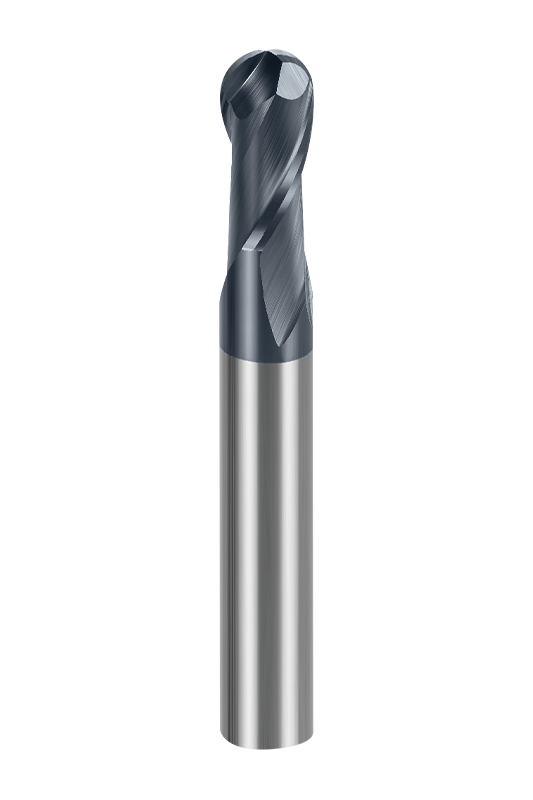 Ultra Hard 2 Flute Ball Nose End Mills• The short blade design greatly improves the wear resistance of the tool and can achieve higher surface quality of the workpiece. • It is mainly used for processing h...View Product →
Soft, sticky materials demand polished flutes, a higher helix and plenty of chip room. Two or three flutes with a bright or diamond-like carbon finish keep built-up edge away, while micro-diameter ball nose tools in the copper electrode range handle the fine ribs and sharp internal corners that EDM electrodes always seem to contain.
Graphite is abrasive and crumbles into dust rather than forming a chip, so a sharp, uncoated or diamond-coated ball nose cutter with strong edge preparation is the usual answer. Air blast extraction is not optional; recutting abrasive dust is the fastest way to destroy an edge.
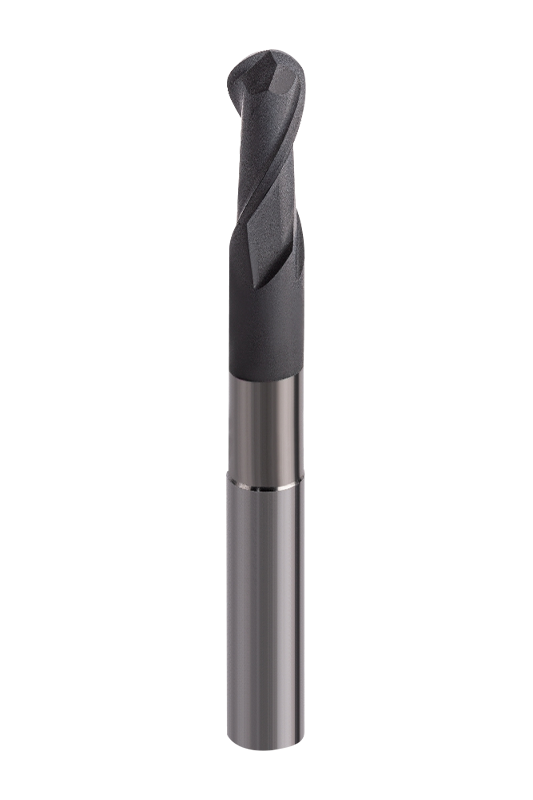 Graphite Machining 2 Flute Ball Nose End Mills• Diamond coating is used with advanced technology to obtain better coating adhesion. • Advanced grinding technology ensures ultra-high coaxiality, high temperature re...View Product →
Here is the detail that trips up most programmers. The very centre of a ball nose tip has zero surface speed, and the effective cutting diameter at the point of contact is only a fraction of the nominal tool size. It is calculated as two times the square root of (R squared minus (R minus ae) squared), where R is the ball radius and ae is the radial stepover.
Take a 10 mm ball nose cutter running a 0.5 mm stepover. The effective diameter at contact is roughly 4.4 mm, not 10 mm, which means the surface speed at the edge is less than half of what the nominal diameter suggests. If your program calculates spindle speed from the tool diameter, the cutter rubs instead of cutting.
Scallop height follows the same logic and is approximately stepover squared divided by eight times the radius. For that same 10 mm cutter and a 0.5 mm stepover, the theoretical cusp height is about 0.006 mm, which is a useful number to know before you promise a customer a polished surface straight off the machine.
Use the effective diameter for spindle speed, then set chip load per tooth according to the material and the flute count. When a surface finish requirement forces a very light stepover, raising the spindle speed is often the only way to keep the edge cutting rather than burnishing.
Tilting the tool by 10 to 15 degrees, a technique known as Sturz milling, moves the contact point away from the dead centre of the ball. This lifts the surface speed at the edge, throws chips forward instead of trapping them under the tip, and typically extends tool life noticeably on deep cavity work. Remember to compensate for the changed effective radius in the program. Our milling cutting speeds chart is a practical starting point for the numbers.
We are a carbide cutting tool manufacturer based in Xixiashu, Changzhou, the tool town at the heart of the Yangtze River Delta, and we sell to the world from here. Our ball nose end mills are produced on imported five-axis and six-axis CNC grinding centres and inspected on high-precision metrology equipment from Germany, Japan and China, all under an ISO9001 quality system. Two professor-level senior engineers and more than ten tooling specialists lead our development work, supported by a long-standing research partnership with East China University of Science and Technology and more than ten patents. Our cutters run daily in defense, aerospace, automotive, electronics and mold applications.
If you would like to know more about Changzhou Maton Tools or discuss a specific ball nose application, our team is always happy to look at your drawings, material and machine setup.
Choosing a ball nose end mill is rarely about finding one perfect tool. It is about matching radius, flute count, coating and stepover to the material in front of you, then giving the cutter enough surface speed at the contact point to cut cleanly instead of rubbing. Get those four things right and the mold comes off the machine closer to finished, the polishing bench gets quieter, and the tooling cost per part quietly drops.

We are End Mills Manufacturer and End Mill Bits Factory. Our Footprints Are Around The World, We provide quality products and services to customers from all over the world.


No.233-3 Yangchenghu Road, Xixiashu Industrial Park, Xinbei District, Changzhou City, Jiangsu Province


+86-18068566610


sales@magotan-tools.com
+86-18068566610
