


 English
 한국어
한국어
 русский

Address:
No.233-3 Yangchenghu Road, Xixiashu Industrial Park, Xinbei District, Changzhou City, Jiangsu Province


Content
Aluminum has a reputation as an easy material, and most of the time it earns that reputation. It cuts fast, it pulls heat away from the cutting edge quickly, and it rarely demands the cautious approach that hardened steel requires. That reputation hides the other half of the story: aluminum is sticky, it builds up on a dull edge within seconds, and it will happily wrap a long stringy chip around a cutter until the flutes pack solid and the tool snaps.
We grind solid carbide end mills in Changzhou, in the middle of China's tool-making cluster, and a large share of the questions that reach our application desk sound almost identical: what RPM, what feed, how many flutes, and why did the last cutter break? This guide answers those questions with the same numbers and the same reasoning we put in front of machine shops every week.
Feeds and speeds are not a single setting. They are four values that depend on each other, and changing one always moves the others.
The two governing formulas are short enough to remember. Spindle speed equals cutting speed multiplied by 3.82 and divided by the tool diameter in inches, or in metric units, cutting speed in m/min multiplied by 1000 and divided by 3.14 times the diameter in millimeters. Table feed equals spindle speed multiplied by feed per tooth multiplied by the number of flutes.
Two rules matter more in aluminum than in almost any other material. First, the chip has to be thick enough to carry heat away from the cut; a chip load below roughly 0.02 mm per tooth means the edge is rubbing, polishing the surface and generating built-up edge instead of removing material. Second, chip evacuation is as important as the numbers themselves, because soft aluminum chips weld to a hot edge with surprising speed.
The table below is a practical starting point for uncoated, polished carbide end mills running in aluminum with air blast or light coolant. The feed per tooth column assumes a 12 mm cutter with moderate radial engagement.
| Aluminum grade | Cutting speed (SFM) | Cutting speed (m/min) | Feed per tooth (mm/tooth) |
|---|---|---|---|
| 6061-T6 | 500 to 800 | 150 to 245 | 0.06 to 0.12 |
| 7075-T6 | 400 to 700 | 120 to 215 | 0.05 to 0.10 |
| 2024-T351 | 350 to 600 | 105 to 185 | 0.05 to 0.10 |
| 5052-H32 | 300 to 500 | 90 to 150 | 0.05 to 0.09 |
| A356 cast aluminum | 400 to 700 | 120 to 215 | 0.06 to 0.10 |
| Unknown grade or remelt stock | 250 to 400 | 75 to 120 | 0.04 to 0.08 |
Treat the chart as a starting point rather than a ceiling. Tool diameter changes chip load more than anything else: a 3 mm cutter cannot take the same tooth load as a 12 mm cutter, so scale the feed per tooth down for small tools and up for large ones. Cast and remelt material deserves the conservative end of the range because hard inclusions and porosity punish a fast, aggressive cut.
The arithmetic is short enough to do at the machine control, and it takes less than a minute.
As a worked example, a 12 mm three-flute cutter in 6061 at 200 m/min gives roughly 5300 RPM. At 0.08 mm per tooth, table feed is 5300 multiplied by 0.08 multiplied by 3, or about 1270 mm/min. In imperial units, a half-inch two-flute cutter at 700 SFM turns at approximately 5350 RPM, and 0.005 in per tooth produces a feed of about 53 IPM.
If your shop also runs steel, stainless or titanium, our milling cutting speeds chart gathers RPM, SFM and feed rate references for those materials in a single reference page.
Numbers only work with a cutter that can survive them. In aluminum, flute count, helix angle and edge preparation decide how much of the calculated performance you actually get.
Two flutes remain the safest choice for slotting, plunging and deep pockets, because the wide gullet clears the soft chip quickly and leaves little chance of packing. Three flutes are the best general-purpose compromise: the stronger core allows a higher table feed at the same chip load, which is exactly what production roughing needs. Four or more flutes belong on high-power machines and in finishing operations with light radial engagement, where chip room matters less than surface quality and metal removal rate.
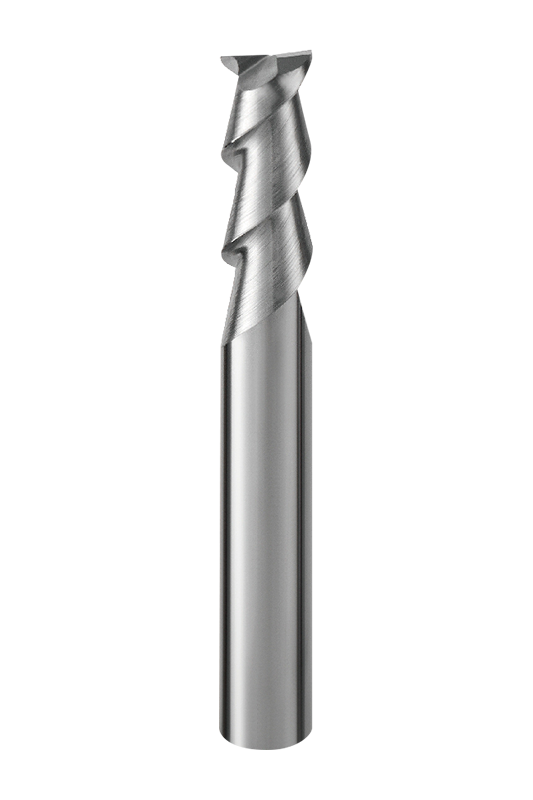 2 Flute End Mills for Aluminum Machining• Special knife design, combined with advanced polishing and passivation technology, effectively prevents vibration and solves the problem of sticking chips. • High-pe...View Product →
Our aluminum series covers both ends of that range, with two-flute geometry for slots and small machines and three-flute designs for shops that want to push feed rates without losing chip clearance.
Aluminum rewards a sharp, polished cutting edge and a high helix angle, typically 40 to 45 degrees, because the steeper helix lifts the chip out of the cut instead of dragging it along the wall. Wave-edge or wavy cutting edges reduce cutting resistance and break the chip into shorter pieces, which helps considerably in deep pockets and in gummy tempers. Coatings need care: conventional titanium aluminum nitride has an affinity for aluminum and encourages built-up edge, while polished uncoated carbide, zirconium nitride or a dedicated low-friction coating performs far better.
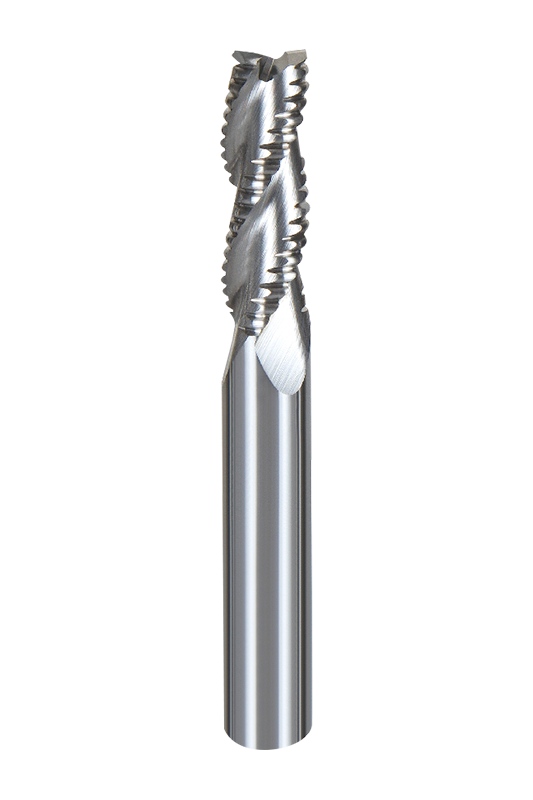 3 Flute Wave Edge End Mills for Aluminum Milling• Special knife design, combined with advanced polishing and passivation technology, effectively prevents vibration and solves the problem of sticking chips. • High-pe...View Product →
For a side-by-side comparison of flute counts and geometry matched to aluminum work, our team has written a practical end mill selection guide for aluminum that walks through the same decisions from the tool crib side.
The chart gives you a cutting speed and a chip load, but the depth of cut decides how much of that performance the machine can physically deliver. There are two broad strategies in aluminum, and both work well when they are applied consistently.
Finishing is different. Keep the radial engagement light, around 5 to 8 percent of the diameter, run full depth in one pass where possible, and feed fast enough that the edge keeps cutting instead of burnishing the wall. Also check spindle power before chasing the upper end of the chart, since aluminum roughing at high metal removal rates can stall a small spindle long before the tool is stressed.
Aluminum does not need flood coolant to survive, but it always needs a way for the chip to leave the cut. Compressed air or a mist system handles most milling work, keeps the work area visible, and avoids the thermal shock and mess of heavy flood coolant. Flood coolant remains useful for deep pockets, pockets with poor access, and any operation where chips would otherwise recirculate under the cutter.
The practical rule is simple: if chips are visible on the floor and not in the pocket after each pass, your evacuation is working. If you see chips being re-cut, hear a change in the sound, or notice the finish worsening toward the end of a pass, stop and fix chip removal before touching the feed and speed values.
Most aluminum problems announce themselves before the part is scrapped. The table below maps the usual symptoms to the adjustment that fixes them fastest.
| Symptom | Likely cause | First adjustment |
|---|---|---|
| Chips weld to the flute edge | Chip load too low, dull or wrongly coated tool | Raise feed per tooth, switch to polished or ZrN tooling |
| Long stringy chips wrapping the cutter | Feed rate too low for the RPM in use | Increase table feed, use wave-edge geometry, add air blast |
| Chatter marks, squealing | Radial engagement too heavy, excessive tool stickout | Reduce radial depth, shorten stickout, lower RPM by 10 percent |
| Poor floor finish | Worn corner radius or too little feed | Replace the cutter, keep the tool moving, raise feed per tooth |
| Cutter breaks in a deep pocket | Chip packing with no escape path | Use a two-flute cutter, add air blast, use helical entry |
One habit separates shops that rarely break cutters from shops that break them weekly: they change one variable at a time and listen to the cut after every change. Two adjustments at once make it impossible to know which one helped.
At a cutting speed of 500 to 800 SFM, a quarter-inch cutter works out to roughly 7600 to 12000 RPM. Check the machine limit first, then pair that spindle speed with a chip load of 0.002 to 0.004 in per tooth, which gives a table feed around 30 to 95 IPM depending on flute count.
Not always. Air blast or minimum quantity lubrication handles the majority of milling jobs and keeps chips moving, while flood coolant is worth the mess in deep pockets, in drilling operations and wherever chips would otherwise be re-cut.
Almost always because the chip load is too small or the cutting edge is no longer sharp. The edge rubs instead of shearing, pressure welds aluminum to the flute, and the built-up edge grows until the finish fails or the tool breaks.
Start lower in 7075. It is stronger and less forgiving of aggressive engagement, so begin near 400 SFM with a moderate chip load and increase only after the cut sounds stable and the chips come off clean and silver.
Aluminum feeds and speeds are ultimately a starting point, not a fixed answer, because every machine, holder and workpiece has its own opinion about what works. The chart gets you into the right range quickly, the formulas keep you honest, and the sound of the cut tells you the rest. That combination is how our application engineers approach every aluminum job that comes through the factory, and it is the fastest route to a stable process that holds tolerance run after run.

We are End Mills Manufacturer and End Mill Bits Factory. Our Footprints Are Around The World, We provide quality products and services to customers from all over the world.


No.233-3 Yangchenghu Road, Xixiashu Industrial Park, Xinbei District, Changzhou City, Jiangsu Province


+86-18068566610


sales@magotan-tools.com
+86-18068566610
