


 English
 한국어
한국어
 русский

Address:
No.233-3 Yangchenghu Road, Xixiashu Industrial Park, Xinbei District, Changzhou City, Jiangsu Province


Content
Ask any machinist about drilling hardened steel and the same stories come back: a glowing drill tip, a squealing spindle, and a hole that refuses to grow. Tool steel at 50 HRC and above behaves less like ordinary metal and more like an abrasive. Once a part has been heat treated, the rules change, and tooling that works perfectly on mild steel will not survive a single hole. Carbide drill bits for hardened steel exist for exactly this situation, but buying the right drill is only half the job. The other half is matching substrate, geometry and cutting data to the hardness sitting in front of you. Here is how we approach that match in our own grinding shop.
High-speed steel is a wonderful material right up to the point where the workpiece becomes as hard as the tool. Heat treated steels such as D2, A2, H13, M2 and fully hardened die steels commonly sit between 45 and 62 HRC, and at that level three things happen at the cutting edge at once.
HSS loses its hardness above roughly 600 degrees Celsius, which is why it polishes hardened steel rather than cutting it. Solid carbide holds its hardness far beyond that window and has the compressive strength to resist the thrust involved. That combination is the whole reason carbide is the default answer here.
Not every carbide drill is a hardened steel drill. Two tools can share a diameter and a shank while behaving completely differently in the cut.
Micrograin and ultra-fine grain carbide with roughly 6 to 12 percent cobalt offers the best balance of edge sharpness and transverse rupture strength. Coarser grades are tougher in impact, but they cannot hold the keen edge hardened steel demands, and a radiused edge simply rubs.
An AlTiN, TiAlN or TiSiN coating acts as a thermal barrier and reduces friction, keeping heat in the chip instead of in the tool. Coatings matter enormously, yet they cannot rescue a soft substrate. Choose the grade first, then the coating.
A 140 degree point angle with a thinned web lowers thrust and helps the drill start without walking. Reinforced margins and a slightly negative edge preparation resist chipping. Flute length should be as short as the hole allows, and internal coolant channels earn their cost as soon as depth passes three diameters. If you want to see how much the point angle alone changes behavior, this comparison of 118 and 135 degree drill points is a useful companion read.
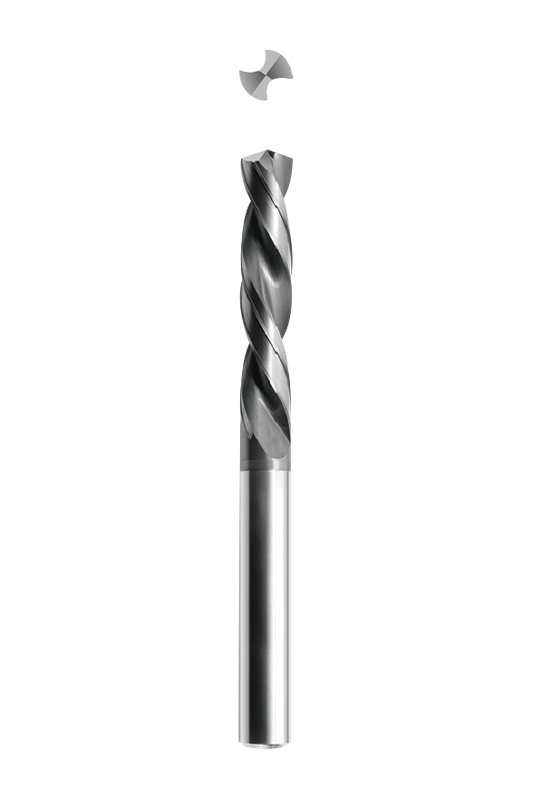 General Purpose Solid Carbide Twist Drill Bits• Suitable for efficient drilling of various materials such as steel, cast iron, stainless steel, etc. • Straight shank twist drill with internal/external cooling.View Product →
Hardness is the single most useful number when selecting a drill. The table below reflects the starting logic we use in conversation with customers.
| Workpiece hardness | Recommended approach | Geometry notes |
|---|---|---|
| Under 30 HRC (pre-hardened 4140, P20) | Standard solid carbide twist drill, AlTiN coated | 135 to 140 degree point, thinned web, 3 to 5xD flute |
| 30 to 45 HRC (H13, hardened P20) | Micrograin carbide drill with AlTiN or TiSiN | 140 degree point, reinforced margin, internal coolant |
| 45 to 55 HRC (D2, A2, M2) | Ultra-fine grain grade, rigid setup, short flute | 140 degree point, negative edge preparation, 3xD max |
| Above 55 HRC (fully hardened die steel) | Helical milling with a high-precision end mill | 4-flute ultra-hard end mill, circular interpolation |
The instinct carried over from mild steel is to slow the spindle and lean on the feed. In hardened steel the opposite is closer to the truth: keep feed per revolution firm so the edge cuts instead of rubbing, and keep surface speed low.
Watch the chips. Silver or straw colored chips mean the process is healthy, while blue or glowing chips mean surface speed or feed is wrong.
Carbide is brittle and hardened steel drilling forgives nothing. Most broken drills we see are caused by the setup rather than the grade.
For holes deeper than five diameters, a dedicated deep hole design with through-coolant geometry makes the difference between a straight hole and a scrapped part.
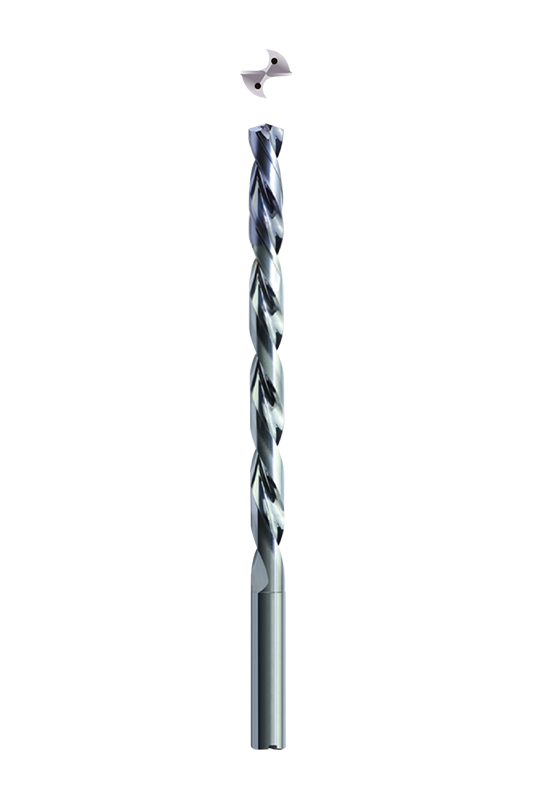 Deep Hole Drills Twist Drill Bits• Suitable for efficient drilling of various materials such as steel, cast iron, stainless steel, etc. • Straight shank twist drill with internal/external cooling.View Product →
Above roughly 55 HRC, or when the hole is large relative to the machine, helical interpolation is often the smarter route. A high-precision end mill plunges at a shallow angle and orbits outward, spreading load along the flute instead of concentrating it at a point. The result is a rounder hole, far less risk of a broken tool buried in a finished part, and position tolerances that hold without a separate reaming operation. Ultra-hard grades with a reinforced edge and a fine micrograin structure are built for exactly this work.
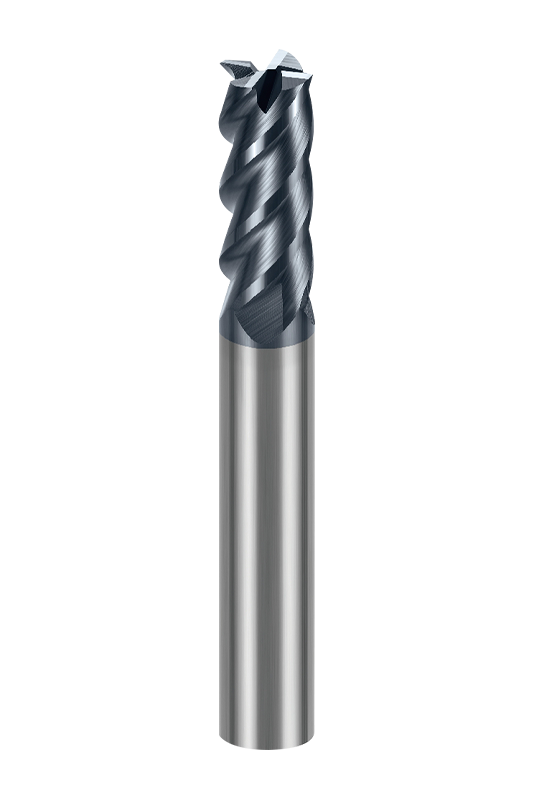 High-Precision 4 Flute Flat End Mills• The short blade design greatly improves the wear resistance of the tool and can achieve higher surface quality of the workpiece. • It is mainly used for processing h...View Product →
Drilling hardened steel is a tooling problem, and a tool only performs as well as the grinding behind it. Changzhou Maton Tools is a carbide tool manufacturer based in Xixiashu, the tool town of the Yangtze River Delta. We grind our drills and end mills on imported five and six axis CNC grinding centers and inspect them with high-precision equipment from Germany, Japan and Switzerland. Our team includes two professor-level senior engineers and more than ten tooling engineers, supported by a long research partnership with East China University of Science and Technology and more than ten patents. We work to ISO9001 and serve customers in aerospace, automotive, electronics, mold making and defense manufacturing.
Our solid carbide drill bits range covers general purpose twist drills, deep hole drills, straight flute drills and three-flute designs. Tell us your material hardness and machine setup, and we will recommend the grade, coating and geometry that fit before you place an order.

We are End Mills Manufacturer and End Mill Bits Factory. Our Footprints Are Around The World, We provide quality products and services to customers from all over the world.


No.233-3 Yangchenghu Road, Xixiashu Industrial Park, Xinbei District, Changzhou City, Jiangsu Province


+86-18068566610


sales@magotan-tools.com
+86-18068566610
