


 English
 한국어
 русский

Address:
No.233-3 Yangchenghu Road, Xixiashu Industrial Park, Xinbei District, Changzhou City, Jiangsu Province


Content
Hardened steel has a way of humbling a toolroom. A cutter that breezes through annealed 4140 will squeal, chip, and die in the same material at 52 HRC, and the failure usually arrives without much warning. The good news is that hardened steel is not off-limits to cutting tools. With the right carbide grade, the right edge preparation, and a toolpath that respects how little heat an edge can absorb, milling cutters work in the 45-62 HRC range every day.
We grind solid carbide tooling for exactly this kind of work, so the notes below follow the conversation we usually have with a customer before an order goes in: what changes when steel gets hard, where the practical ceiling sits, and which decisions actually keep a cutter alive through a full batch.
Hardness changes the way a tool fails. In soft steel a cutter wears gradually along the flank, and you get hours of warning before the edge goes away. Above roughly 45 HRC, failure is sudden instead: a small chip on the cutting edge, a notch worn at the depth-of-cut line, then a cascade of breakage that ruins the part as well as the tool.
Three mechanisms are doing the damage:
The practical consequence is that a cutter for hardened steel is not simply a general-purpose end mill with a harder coating. Substrate, edge prep, flute count, and corner form all shift together.
There is no single number, but there are useful bands. The table below is the rough map we use when a customer tells us a hardness figure over the phone.
| Steel condition | Hardness | Practical approach |
|---|---|---|
| Annealed or normalized | Under 30 HRC | General-purpose carbide, 2 to 4 flutes |
| Pre-hardened mold steel | 30 to 40 HRC | Standard carbide with AlTiN coating, 4 flutes |
| Hardened tool steel | 45 to 55 HRC | High-hardness grade, reinforced edge, 4 to 6 flutes |
| Fully hardened | 55 to 62 HRC | Ultra-hard grade, light radial engagement, very rigid setup |
| Beyond milling | Above 62 HRC | Grinding, EDM, or a dedicated thread mill |
Two things are worth saying about the top row. First, 62 HRC is the area where carbide milling becomes uneconomical rather than impossible; a good setup can still take light finishing passes. Second, thread milling and some forms of finishing can push past that line because the cut is continuous and the tool loads are gentler than they look.
For work above 45 HRC, start with a fine-grain carbide carrying a PVD coating such as AlTiN or AlCrN. The coating is not there just to add hardness. Its real job is to slow the transfer of heat into the substrate so the edge keeps its compressive strength. Thicker is not automatically better either: an overly thick layer spalls off in hard cutting, taking substrate with it. Adhesion and heat resistance matter more than microns.
The details that matter most are unglamorous. A reinforced edge, typically a small T-land or a controlled hone, trades a little sharpness for a lot of edge strength. A slightly negative rake does the same. A heavy core and a short flute length resist the deflection that causes chipping, and a corner radius, even a modest one, spreads load that would otherwise concentrate on a sharp corner and break it off.
Flute count is a balance. Four to six flutes reduce chip load per tooth for a given feed rate and leave a better floor finish, which is why finishing cutters for hard steel tend to be on the high side. The trade-off is chip room, so roughing passes still favour fewer flutes and a purpose-built roughing geometry.
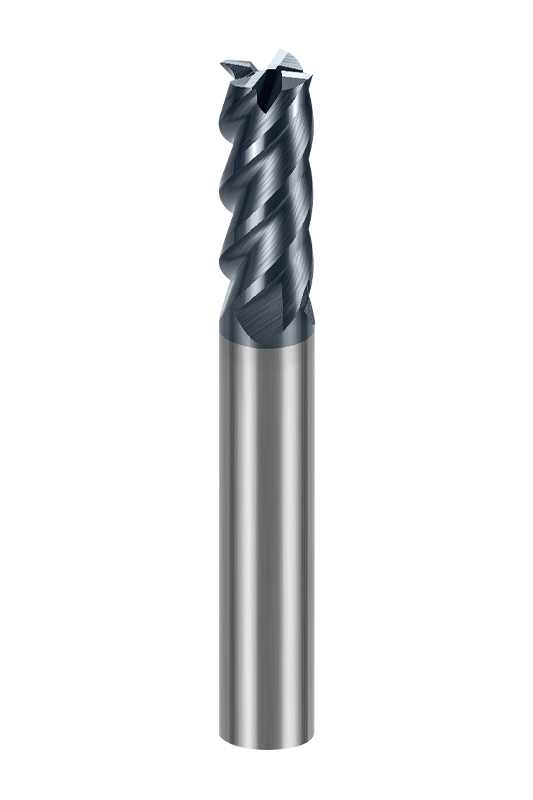 High-Precision 4 Flute Carbide End Mills for Hardened SteelFor finishing hardened steel from HRC45 to HRC70, this 4-flute carbide range offers 1–12 mm diameters and short-blade geometry.View Product →
Use the largest diameter the part allows and keep stickout as short as you can get away with; three times diameter is comfortable, four is workable, and beyond that you are managing chatter rather than cutting steel. Where a deep rib forces a micro cutter into a corner, expect to slow down and to change tools more often. Resigned acceptance of that is part of hard machining.
The numbers below are starting points for coated carbide in hardened steel, not prescriptions. Every machine, holder, and part geometry shifts them.
One more parameter deserves its own line: runout. A holder that runs out by 20 microns loads one flute harder than the rest, and in hardened steel that flute fails first. Check it, and fix it, before blaming the tool.
 High Performance 4 Flute End Mills for Soft and Hard MaterialsWhen runout and holder setup affect tool life, this 4-flute NNH range covers 1–20 mm and is described for both soft and hardened materials.View Product →
Milling a hardened surface is one problem. Making a hole in it is another, because the tool is buried and the chips have nowhere to go. Solid carbide drills with a 140 to 150 degree point, a thinned web, and through-spindle coolant handle hardened steel well up to around 55 HRC, provided the hole is not too deep relative to diameter and the drill is not allowed to dwell. If you are working through the details of drill selection, speeds, and setup, our guide to carbide drill bits for hardened steel covers the practical side in more depth.
Threads are the classic headache. Tapping above 45 HRC is a gamble: the tap has a lot of engagement, torque spikes, and a broken tap in a finished mold is a salvage job. Thread milling solves most of it. The cutter engages a small arc at a time, the chips are short and controllable, and one tool covers a range of diameters. For the very hard end of the range, a two-row superhard thread mill can cut threads in material up to 65 HRC, which is territory where drilling would be hopeless.
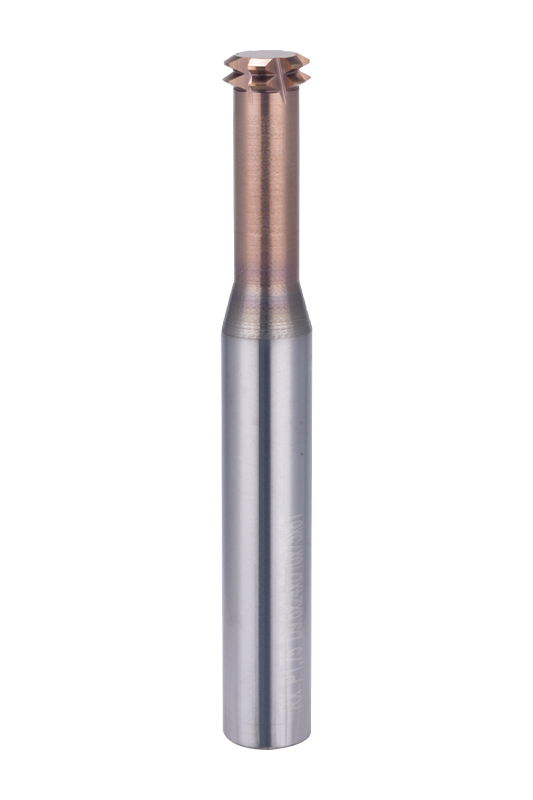 Metric Superhard Two-Row Thread Milling Cutter for Hard MaterialsFor thread milling in hardened workpieces up to 65 HRC, this metric cutter covers M1.6–M12 and uses two rows of cutting teeth.View Product →
We sell cutting tools, so it would be convenient to say milling always wins. It does not. Wire EDM remains the sensible choice for a through hole with a tight tolerance, a sharp internal corner, or a thin wall that will not tolerate cutting force. Die-sinking EDM handles cavities in steels too hard or too awkward for a rotating tool. Surface grinding still beats milling where the finish specification is fine and the surface is flat.
The honest comparison is cost per part, not cost per operation. Hard milling can often finish a feature in one setup on a five-axis machine and eliminate a second operation, a second fixture, and a queue at the EDM. Where that is true, milling wins comfortably. Where the geometry demands a square internal corner at 60 HRC, it does not, and no amount of tool geometry changes that.
Most of the difficulty with hardened steel comes down to matching three things: a grade hard enough to resist abrasion, an edge strong enough to survive the load, and a toolpath gentle enough not to overload either. Get those aligned and 55 HRC stops being intimidating.
If you are unsure which side of the line your part sits on, send us the steel grade, the measured hardness, and a sketch of the feature you need to cut. Our engineers will suggest a starting geometry and a parameter set rather than a catalogue page, and you are welcome to look around our factory in Xixiashu to see how the tools are ground and inspected before they ship.

We are End Mills Manufacturer and End Mill Bits Factory. Our Footprints Are Around The World, We provide quality products and services to customers from all over the world.


No.233-3 Yangchenghu Road, Xixiashu Industrial Park, Xinbei District, Changzhou City, Jiangsu Province


+86-18068566610


sales@magotan-tools.com
+86-18068566610
