


 English
 한국어
 русский

Address:
No.233-3 Yangchenghu Road, Xixiashu Industrial Park, Xinbei District, Changzhou City, Jiangsu Province


Content
Walk into any machine shop and ask two machinists whether cobalt or carbide drill bits are "better", and you will usually get two confident, completely opposite answers. Both of them are right, and that is exactly the problem. The two tools are built for different jobs under different conditions, and most of the arguing comes from treating them as rivals in the same race. We grind solid carbide drills for a living, and we still recommend cobalt bits to plenty of customers, so what follows is not a sales pitch. It is simply the way of thinking about the choice that has held up best in real shops.
Cobalt drill bits are high-speed steel. The word on the label refers to roughly 5% cobalt in M35 steel or 8% in M42, alloyed into the melt to raise red hardness, which is the ability of the edge to keep cutting after it has turned colour. The bit is machined and ground from a solid bar of steel, so it is tough, inexpensive and easy to resharpen on a bench grinder.
Carbide drill bits are a powder-metallurgy product. Tungsten carbide grains are pressed and sintered with a metallic binder, usually between 3% and 10% cobalt, into a blank that is then ground to its final geometry on diamond wheels. The finished tool is dramatically harder and stiffer, and it is also much more brittle.
Here is the detail that surprises almost everyone the first time they hear it: both bits contain cobalt. In the HSS bit, cobalt is an alloying element inside the steel. In the carbide bit, cobalt is the glue that holds the carbide grains together. The word on the packaging tells you very little on its own; what matters is the material behind it.
If you remember only one thing from this article, remember hot hardness. A cobalt bit begins to soften around 600 °C at the cutting edge, while a carbide bit keeps its hardness well past 900 °C. That single gap sets off a whole chain of consequences: surface speed, feed rate, rigidity requirements and price.
| Property | Cobalt (M35 / M42) | Solid carbide |
|---|---|---|
| Base material | High-speed steel with 5–8% Co | Tungsten carbide grains in a 3–10% Co binder |
| Hardness | About 64–67 HRC | About 90 HRA, roughly 1500 HV |
| Hot hardness limit | Around 600 °C | Around 900–1000 °C |
| Stiffness | Reference level | Roughly three times stiffer |
| Cutting speed in mild steel | 25–40 SFM | 150–250 SFM |
| Failure mode when abused | Dulls, overheats, work-hardens the hole | Chips or fractures at the corner |
| Setup needed | Hand drill or drill press is fine | Rigid CNC, low runout, coolant |
| Resharpening | Bench grinder, a few minutes | Diamond wheel, controlled geometry |
| Best fit | Site work, repair, mixed material, low volume | Production, abrasive or hard material, tight tolerance |
The table also explains the price gap. A carbide bit costs several times what an equivalent cobalt bit does, and it only pays that back when the machine can use the speed the tool allows. Bought for a wobbly drill press, it is simply an expensive bit that chips.
Cobalt bits have one enormous advantage that no table of hardness numbers can capture: they forgive you. A hand drill with a worn chuck, a piece of angle iron clamped to a bench, a maintenance job at eleven at night with no coolant in sight — that is cobalt territory, and it has been for decades.
None of that is nostalgia. If your setup cannot hold the drill on centre, keep a steady feed and deliver coolant, the harder tool is not the better tool.
Put a carbide bit in a rigid CNC spindle with a proper holder and coolant, and the comparison stops being interesting. Because the edge survives much higher temperatures, you can run several times the surface speed, and that turns directly into shorter cycle times, better hole position and consistent hole size over thousands of parts.
Carbide also handles the materials that eat HSS for breakfast: cast iron with its abrasive skin, high-silicon aluminium, abrasive composites and anything above roughly 45 HRC. In those materials the cobalt bit does not lose on speed, it loses on survival.
All of that comes with conditions. Carbide wants concentricity, minimal runout at the tip, a pecking or through-coolant strategy that clears chips, and a machine that does not flex. Holding those conditions is a discipline rather than a purchase, which is why the same thinking shapes our own grinding floor as much as it shapes the tool geometry.
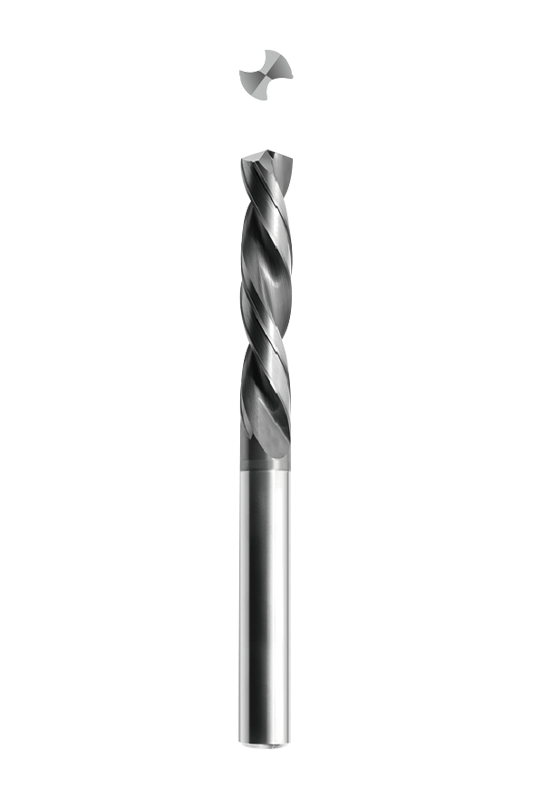 General Purpose Solid Carbide Twist Drill Bits, NNZT SeriesCovers mild steel, stainless steel, cast iron and more, with external or internal cooling and 3D to 8D options for matching the workpiece.View Product →
Material is the fastest filter of all. Before you think about coatings or point angles, ask what the drill will actually be biting into.
Mild steel is friendly to both tools, so the decision usually comes down to volume. Stainless steel is where the choice gets interesting. Grades like 304 work-harden the moment a tool rubs instead of cutting, and a cobalt bit run slowly with cutting oil and a firm, continuous feed can produce perfectly good holes all day. In production, a carbide drill fed correctly at five times the speed will leave it behind, provided the feed never hesitates.
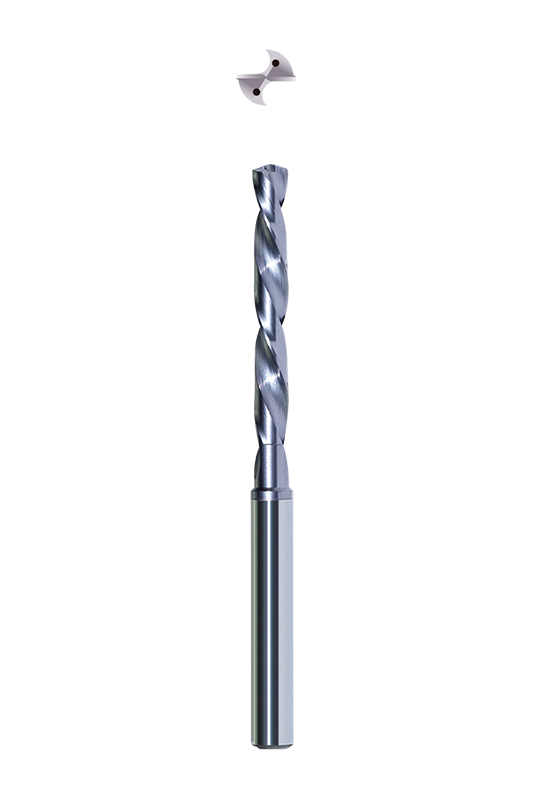 NNZB Series Twist Drills for Mild Steel and Stainless SteelFor stainless steel and mild steel drilling, with internal cooling, sharp edges and material-specific speed tables.View Product →
Cast iron is abrasive and throws dusty chips that grind an HSS edge down; carbide tolerates that far better. Aluminium is the opposite problem — gummy, prone to built-up edge, and happiest with sharp polished flutes, generous rake and high helix. A three-flute design is a good middle ground for these two families, balancing chip room with a stronger core than a two-flute drill.
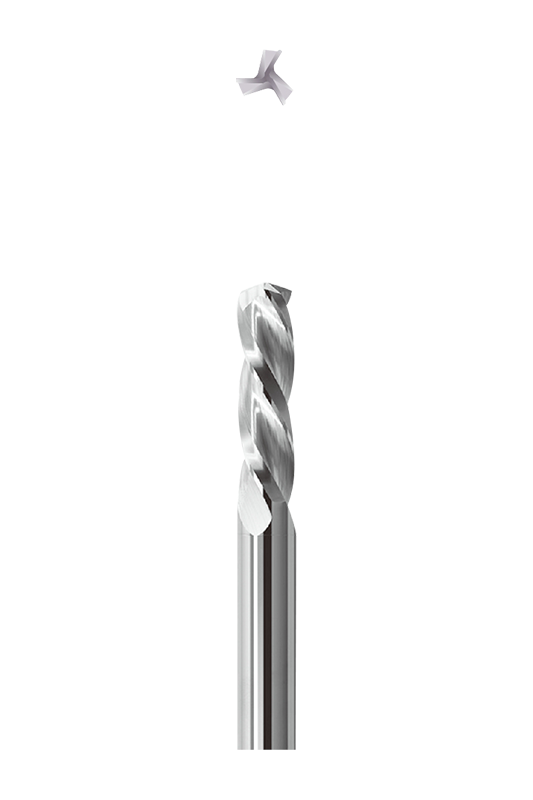 Custom Solid Carbide 3-Flute Drills for Cast Iron and AluminumThree-flute design balances chip room and core strength for cast iron and aluminum, with 3D external and 15D internal cooling.View Product →
Above about 45 HRC the argument is over: HSS will not survive at any useful cutting rate, and carbide is the only practical answer. Titanium is a different case again. Its low thermal conductivity keeps heat in the cutting zone rather than in the chip, so sharp edges, moderate speed, high feed and flood coolant matter more than raw hardness. The same rule applies to abrasive composites, where edge retention decides tool life.
Most premature failures we are shown are not material failures at all — they are speed failures. Spin a cobalt bit too fast and the corners burn away in a shower of blue chips. Push a carbide bit too slowly and it rubs, polishes the surface, work-hardens it and then breaks.
If your shop runs cobalt, keep practical starting points close to the machine; this summary of cobalt drill speeds and feeds covers the common steels and is a sensible baseline. Carbide follows the same logic in reverse: start faster than feels comfortable, keep the feed heavy enough to stay in cut, and let coolant do the rest.
When a customer asks us which way to go, we run through a handful of questions. They usually settle the matter in under a minute.
Cobalt for uncertainty, low speed and mixed work; carbide for repetition, tight tolerance, abrasive or hard material, and a machine that holds the tool still. Neither is an upgrade of the other — they are answers to different questions.
If you tell us the material, the machine and the hole, we can point you to the right side of that line, and it is not always the side we sell.

We are End Mills Manufacturer and End Mill Bits Factory. Our Footprints Are Around The World, We provide quality products and services to customers from all over the world.


No.233-3 Yangchenghu Road, Xixiashu Industrial Park, Xinbei District, Changzhou City, Jiangsu Province


+86-18068566610


sales@magotan-tools.com
+86-18068566610
